
Footwear Insights
How to Audit a Shoe Factory Before Placing an Order

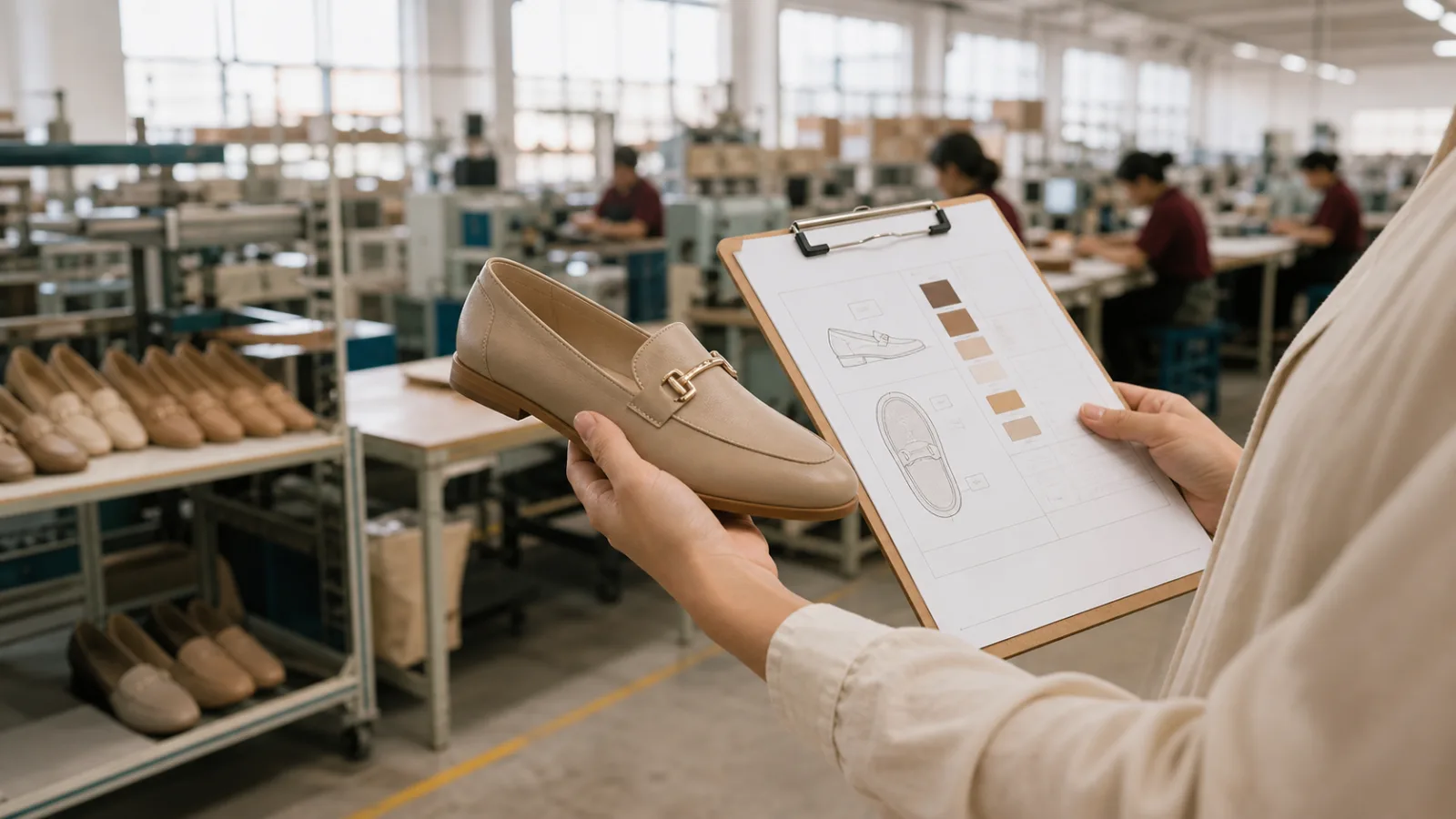
A useful shoe factory audit proves three things before money and materials are committed: the supplier is the legal and physical operation it claims to be, its production system can make your specified shoe consistently, and material risks have owners and deadlines. Review documents before the visit, follow one product through the real factory, interview people, sample records and close every major finding with evidence—not promises.
An audit is not a certificate hunt. ISO 19011:2026 describes management-system auditing as an evidence-based, risk-based process; the OECD’s footwear guidance likewise warns that documents alone may be insufficient for risks such as forced labour. Your audit should therefore connect records, observations and interviews.
What should a shoe factory audit cover?
Use six workstreams. A factory can look tidy and still fail on material control, subcontracting or production planning.
| Workstream | Evidence to request | What to verify on site |
|---|---|---|
| Legal identity | Business licence, registered address, bank beneficiary, export entity | Company name matches the building, invoices and payment account |
| Product capability | Style list, machinery list, sample records, technician responsibilities | The relevant construction is running or can be demonstrated |
| Capacity and planning | Order board, line plan, attendance and maintenance records | Real bottlenecks, peak-season load and reliance on overtime |
| Quality system | Approved-sample control, incoming checks, in-line and final reports | Inspectors use current specifications and record failures |
| Materials and traceability | BOM, purchase orders, batch or lot records, supplier list | Materials can be traced from receiving to finished cartons |
| Labour, safety and environment | Policies, payroll/time records, training and incident logs | Fire exits, guards, ventilation, chemical storage and worker feedback |
Treat certificates as leads to verify. Confirm the issuing body, certificate number, legal entity, address, scope and expiry date with the issuer when possible. ISO 19011 itself is guidance for auditing; it is not a certification that proves a factory is suitable.
Step 1: Define the audit scope before the visit
Send the auditor a one-page brief containing the product category, construction, materials, target market, expected order range, critical tests and any restricted subcontracting. A high-heel project needs different technical evidence from a cemented slipper or sneaker.
Ask the supplier to return these items in advance:
- Legal company and export details.
- Organization chart and responsible contacts.
- Factory layout and principal machine list.
- Current production schedule with customer names redacted.
- Quality manual, recent inspection records and corrective actions.
- List of outsourced processes and locations.
- Material suppliers for the proposed construction.
Unexplained differences between the quotation entity, factory entity and payment beneficiary deserve resolution before a deposit.
Step 2: Map the real production flow
Walk in material-flow order: receiving, material inspection, storage, cutting, stitching, preparation, lasting or assembly, bonding, finishing, inspection, packing and finished-goods storage. Select one current style and trace its work order, approved sample, BOM and QC records across those stages.
For women’s footwear, inspect operations that affect fit and appearance: pattern control, pairing, seam allowance, toe shape, bonding, heel attachment, outsole alignment and shade matching.
Do not accept a showroom tour as an audit. If cutting, stitching, outsole molding, printing or packing occurs elsewhere, record the subcontractor, process, approval method and traceability. OECD footwear guidance recommends risk-based assessment beyond the immediate facility when risks sit upstream.
Step 3: Test capacity with arithmetic
Do not ask only, “What is your monthly capacity?” Build a style-specific capacity check.
| Input | Example planning value* |
|---|---|
| Available line hours per day | 8 hours |
| Working days in the planned window | 22 days |
| Demonstrated output for the relevant style | 600 pairs/day |
| Already committed load | 70% |
| Theoretical open output | 3,960 pairs |
\*These are illustrative buyer inputs, not D6 performance data or a production promise.
Then challenge the weakest operation. A line may assemble 600 pairs daily while a buckle supplier or finishing station supports less. Ask for records from comparable styles and peak-season commitments. A credible factory explains constraints instead of presenting one maximum number.
Step 4: Audit quality controls against your shoe
Bring your tech pack or reference sample. At minimum, verify that the factory can control:
- Document revision: only the current specification and approved sample reach production.
- Incoming materials: identity, color, thickness or other defined properties are checked.
- First-piece approval: setup errors are caught before a full batch runs.
- In-line inspection: findings lead to containment and correction, not only a report.
- Measurement and test equipment: tools are identified and fit for their purpose.
- Nonconforming product: rejected material and shoes are segregated and dispositioned.
- Final inspection: cartons are complete and the lot is randomly sampled to an agreed plan.
ISO 2859-1:2026 provides AQL-indexed acceptance-sampling schemes for lot-by-lot inspection, but an AQL is not permission to ship known defects. Define critical, major and minor defects in the purchase specification. See D6’s footwear inspection and AQL guide for a buyer-oriented workflow.
Step 5: Check labour and safety through evidence
The OECD identifies footwear-sector risks including child and forced labour, working time, occupational safety, hazardous chemicals, pollution and bribery. The ILO’s sector code calls for hazard controls, training and periodic safety inspections.
Inspect unobstructed exits, machine guards, electrical panels, ventilation, adhesive and chemical labels, safety-data access, personal protective equipment and accident records. Interview a small cross-section of workers privately where lawful and appropriate. Compare interview answers with time, wage and training records; never treat a coached group interview as sufficient evidence.
Serious life-safety hazards, evidence of forced labour, falsified records or undisclosed production sites should trigger escalation, not a routine “improve later” note.
Step 6: Turn findings into an order decision
Classify findings by risk, not cosmetic appearance.
| Finding level | Typical response |
|---|---|
| Critical | Stop qualification or order release until independently verified closure |
| Major | Correct before deposit, material commitment or production—depending on exposure |
| Minor | Time-bound corrective action with named owner and evidence |
| Improvement | Monitor without representing it as nonconformity |
A corrective-action plan should state the root cause, containment, permanent action, owner, due date and proof. Photographs help, but revised procedures, training records and a follow-up visit may be needed. Re-audit high-risk items before the commercial milestone they protect.
FAQ
Can a remote shoe factory audit replace an on-site visit?
A remote review can verify documents and show live production, but it limits independent observation and worker confidentiality. Use it for screening or follow-up, not as automatic proof.
Should the buyer use an independent auditor?
Use an independent auditor when order value, geography, compliance exposure or technical complexity warrants it. The buyer must still define product-specific scope and criteria.
How often should a footwear supplier be audited?
Set frequency by risk and performance. Reassess after ownership, location, process or subcontractor changes, serious failures or repeated quality problems.
Does a passed audit guarantee product quality?
No. An audit evaluates capability and controls at a point in time. Approved samples, specifications, production monitoring, testing and shipment inspection remain necessary.
Audit the system, then qualify the order
The best supplier decision combines a risk-based factory audit with a style-specific development plan. Review D6’s OEM versus ODM decision guide and send your style, quantity, target market and launch window to discuss a suitable sourcing route.
Sources & references
- ISO, *ISO 19011:2026 — Guidelines for auditing management systems*: https://www.iso.org/standard/19011
- ISO, *ISO 2859-1:2026 — Sampling procedures for inspection by attributes*: https://www.iso.org/standard/85464.html
- OECD, *Due Diligence Guidance for Responsible Supply Chains in the Garment and Footwear Sector*: https://www.oecd.org/content/dam/oecd/en/publications/reports/2018/03/oecd-due-diligence-guidance-for-responsible-supply-chains-in-the-garment-and-footwear-sector_g1g89b0b/9789264290587-en.pdf
- International Labour Organization, *Safety and health in textiles, clothing, leather and footwear*: https://www.ilo.org/sites/default/files/wcmsp5/groups/public/%40ed_dialogue/%40sector/documents/normativeinstrument/wcms_828429.pdf