
Footwear Insights
Common Shoe Defects: Causes, Classification and Corrective Actions

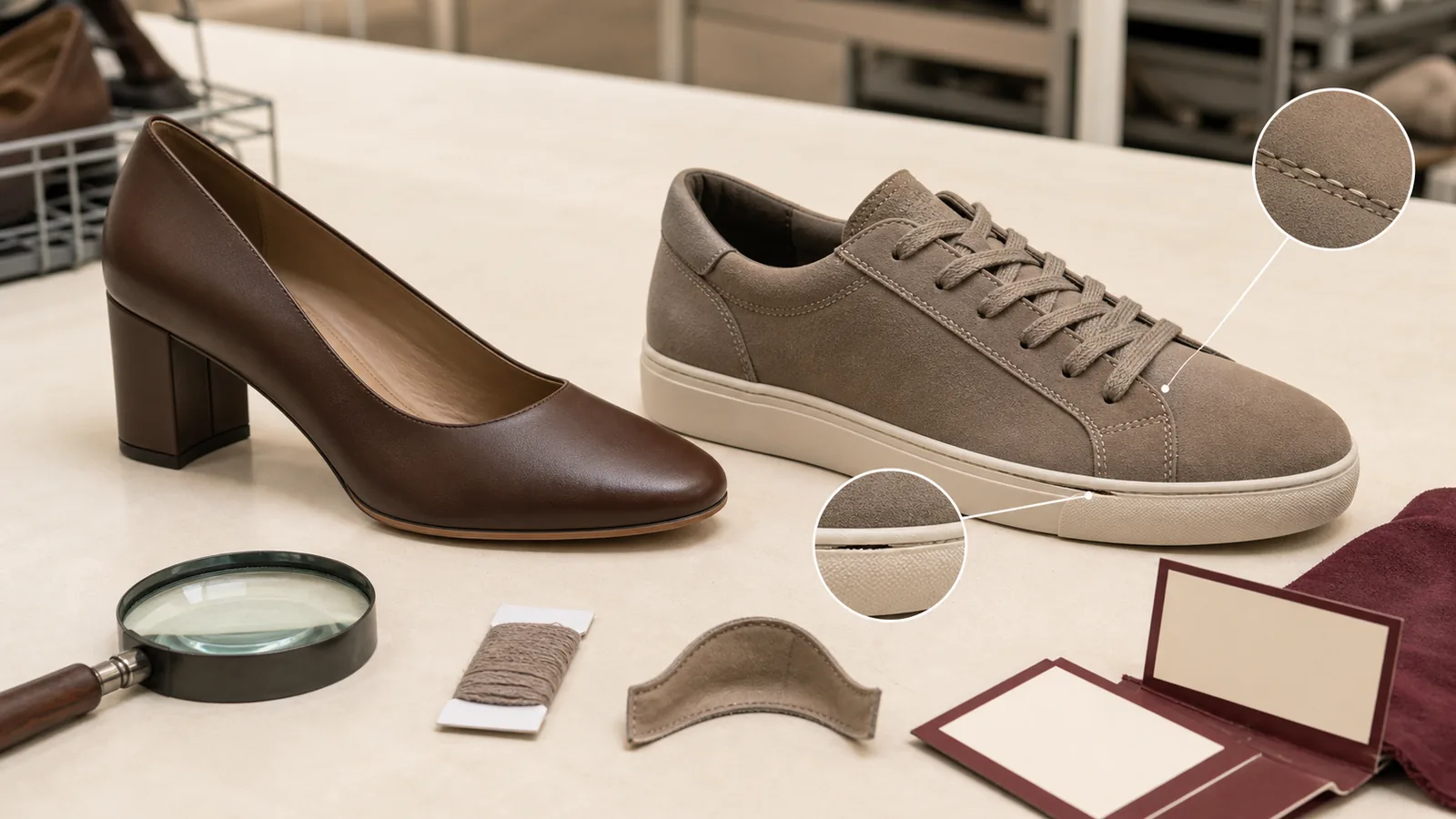
A useful footwear defect system does three things: describes what is wrong, classifies its effect on sale or safety, and sends the problem to the process that can prevent recurrence. “Bad workmanship” is not a corrective action. Buyers need a defect name, location, severity, evidence, suspected cause, containment decision and verified fix.
This guide covers ordinary fashion and casual footwear. Product specifications, intended use and destination rules determine the final acceptance criteria.
Classify severity before counting defects
Agree the definitions in the inspection specification before production:
| Class | Practical meaning | Typical disposition |
|---|---|---|
| Critical | A safety, legal or serious compliance risk, or a defect that may cause harm in foreseeable use | Stop release; isolate affected stock; investigate scope |
| Major | Likely to cause a customer return, functional failure or refusal to buy | Rework or reject according to the agreed sampling plan |
| Minor | Workmanship departure that does not materially affect use and is less noticeable | Count against the agreed minor limit; monitor trend |
The same observation can change class by context. A loose decorative trim may be major on an adult shoe but potentially critical if it becomes an accessible small part on children’s footwear. A shade difference hidden under the footbed is not equivalent to one across the two visible uppers of a pair.
ISO 2859-1:2026 provides AQL-indexed sampling schemes for lot-by-lot inspection. It determines sample size and acceptance/rejection numbers from the agreed lot and inspection settings; it does not decide whether a shoe defect is critical, major or minor. That classification belongs in the buyer-approved defect list.
Defect-to-action table
| Defect observed | Likely process causes to investigate | Classification considerations | Corrective action and verification |
|---|---|---|---|
| Upper-to-sole opening | Inadequate roughing or cleaning, wrong adhesive/open time, poor pressing, contamination, incompatible materials | Usually major; potentially critical if rapid separation creates a fall risk | Quarantine affected lots; verify surface preparation and adhesive controls; test production bonds |
| Crooked lasting or asymmetric pair | Last not seated, uneven pulling, incorrect pattern marks, poor operator method | Major when shape/fit is visibly or functionally affected | Check pattern/lasting marks, fixtures and pair matching; approve first-off pairs |
| Wrinkles, puckering or topline waves | Pattern/last mismatch, material stretch variation, uneven stitching or lasting tension | Minor to major by visibility and fit effect | Set visual limit sample; control skiving, stitching and tension; retrain at source operation |
| Skipped, loose or broken stitches | Needle/thread mismatch, tension or feed problem, poor back-tack | Major where seam strength is affected; minor for isolated non-structural appearance | Stop and adjust machine; repair only with approved method; inspect seam start/end points |
| Shade or grain mismatch within a pair | Mixed material lots, cutting without shade zoning, uncontrolled lighting | Usually major on prominent panels | Segregate lots; cut and pair under specified lighting; retain approved shade range |
| Excess adhesive, stain or abrasion | Uncontrolled application, dirty fixtures, handling contact, aggressive cleaning | Minor to major depending on visibility and permanence | Protect surfaces, control adhesive quantity, clean workstation; prohibit damaging cosmetic cover-up |
| Incorrect size/box/barcode | Mixed work-in-progress, wrong label mapping, packing-line verification gap | Major; may create retailer chargebacks or traceability failure | Isolate packed stock; three-way match shoe, box and PO; scan every variable-data version |
| Loose heel or top piece | Incorrect fastener/seat, weak material, poor attachment process | Major or critical depending on failure mode | Hold shipment; verify heel attachment and top-piece retention with relevant test plan |
| Loose buckle, eyelet, charm or strap | Insufficient setting force, wrong backing, weak substrate or attachment design | Major; assess small-part or injury risk for intended user | Check component specification and setting; perform attachment-strength verification |
| Odor, mold or moisture damage | Wet materials, inadequate drying, humid packing or container conditions | Major; compliance/safety review may be required | Isolate stock, identify moisture source, review material conditioning and pack-out controls |
The table identifies investigation routes, not automatic root causes. Confirm the cause with process records, retained materials and controlled trials.
Four steps from defect photo to corrective action
1. Contain the shipment
Identify affected purchase order, style, color, size range, line, shift, material lot and packing dates. Stop packing or shipment when the risk warrants it. Mark suspect stock physically and in the inventory system so it cannot re-enter accepted goods unnoticed.
Containment answers “What stock is at risk now?” It is separate from prevention.
2. Describe the defect reproducibly
Record the shoe side, component, exact location, measured extent and frequency. Photograph the entire pair, then a close-up with scale and the carton or batch identity. Attach the approved sample or tolerance reference.
Replace “sole bad” with a statement such as “right shoe, medial forepart, visible upper-to-outsole opening extending approximately 18 mm.” A second inspector should be able to reach the same finding.
3. Trace the process cause
Walk backward through packing, finishing, assembly, stitching, cutting and incoming material. Check what changed: supplier lot, operator, machine setting, adhesive batch, temperature, dwell time, pattern revision or approved substitute.
For sole separation, ISO 17708:2018 describes a whole-shoe method for assessing resistance to upper/outsole separation and includes ageing conditions usable for production control. For women’s medium and high heels, ISO 22650:2018 addresses heel attachment; ISO 24263:2020 covers attachment strength of straps, hooks, eyelets and trims. Select methods and performance requirements with a qualified laboratory for the actual construction and end use.
4. Verify effectiveness
A correction repairs affected shoes. A corrective action changes the process so the defect does not return. Require evidence such as revised work instruction, parameter record, fixture change, operator qualification and results from newly produced units.
Then inspect the next defined production quantity or lot. Close the action only when evidence shows the process is stable—not when a form has been signed.
Buyer controls that prevent repeated disputes
- Issue a style-specific defect list with photographs and severity classes.
- Define measurement method and viewing conditions for cosmetic limits.
- Freeze the approved sample, bill of materials and packaging data.
- Require written approval for material, supplier or construction changes.
- Inspect early production, when corrections can still protect the order.
- Track defects per inspected unit and by operation, not only total rejected pairs.
- Escalate repeat defects even when one lot narrowly passes sampling.
- Link claims and returns back to production batch and corrective-action record.
D6’s footwear inspection and AQL checklist explains how sampling fits into shipment inspection. Buyers developing private-label styles should also settle responsibilities through the OEM versus ODM framework before approving bulk.
FAQ
Is an AQL the allowed percentage of defective shoes in a shipment?
Not directly. AQL is an index used with a sampling scheme to select sample size and acceptance/rejection thresholds. It is not permission to ship that percentage defective.
Can inspectors reclassify a defect during final inspection?
Only through an agreed escalation process. Unilateral reclassification creates inconsistent results. Borderline examples should be resolved against the approved defect list and limit samples.
Should repaired shoes automatically pass?
No. Rework must use an approved method and the pair must be reinspected for function, appearance and secondary damage. Some safety or material failures may not be suitable for repair.
What is the difference between correction and corrective action?
Correction handles the observed product—for example, repacking a mislabeled pair. Corrective action changes the process, such as adding a barcode-to-shoe scan that prevents recurrence.
When is laboratory testing necessary?
Use it when the risk cannot be judged reliably by visual inspection or a simple field check, including bond strength, attachment strength, material performance and regulated substances. The buyer should agree methods and requirements before production.
Turn inspection findings into production control
The best defect report is short, specific and actionable. Send D6 the style specification, intended market, defect limits and required test plan through the project inquiry page so quality checkpoints can be planned before bulk production.
Sources & references
- ISO, *ISO 2859-1:2026—Sampling procedures for inspection by attributes*: https://www.iso.org/standard/85464.html
- ISO, *ISO 17708:2018—Footwear: Upper sole adhesion*: https://www.iso.org/standard/68281.html
- ISO, *ISO 22650:2018—Footwear: Heel attachment*: https://www.iso.org/standard/63247.html
- ISO, *ISO 24263:2020—Attachment strength of straps, trims and accessories*: https://www.iso.org/standard/78248.html
- ISO, *ISO 24264:2020—Top piece attachment strength*: https://www.iso.org/standard/78249.html