
Footwear Insights
How to Write a Footwear Tech Pack That Factories Can Quote

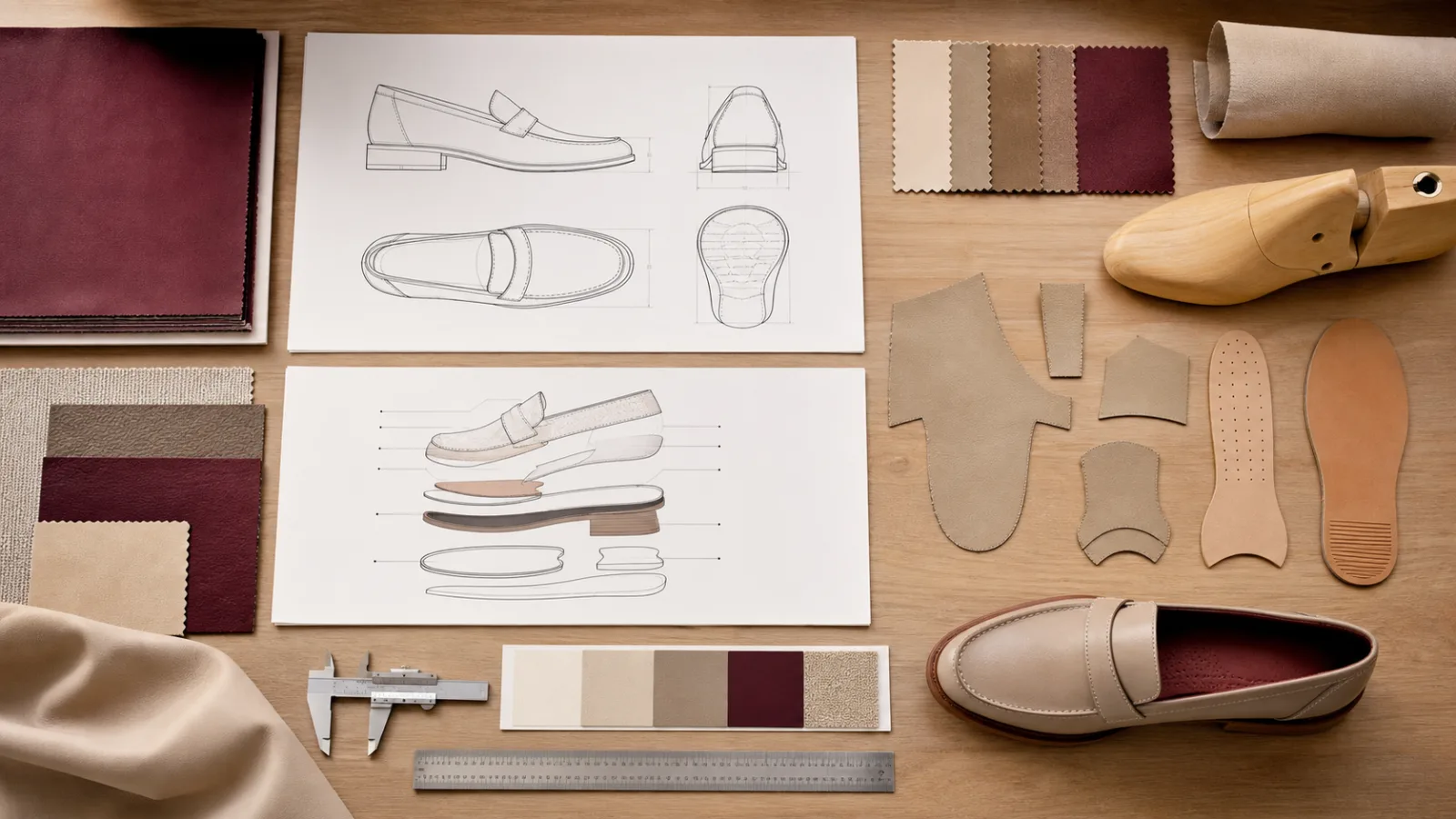
A factory-ready footwear tech pack converts a design into named materials, measurable construction details, size and fit rules, artwork, packaging and acceptance criteria. It should let two qualified factories quote the same product scope and let the approved specification move into sampling without guessing. Start with one controlled PDF plus linked artwork files, give every page a style number and revision, and mark unknowns as decisions—not blanks.
A sketch is not a tech pack. The factory needs to know what is fixed, optional or requires tooling.
What belongs in a footwear tech pack?
| Section | Minimum useful content | Why it affects the quote |
|---|---|---|
| Style identity | Brand, style number, category, season, revision and date | Prevents files from different versions being mixed |
| Drawings | Medial, lateral, top, back and outsole views | Shows panels, seams, edges and component placement |
| Bill of materials | Component, material, color, thickness/grade, supplier if nominated | Defines what is being purchased and developed |
| Construction | Stitching, edge finish, reinforcement, lasting/bonding and assembly notes | Determines operations, machinery and labour |
| Last and sizing | Last reference, sample size, size range, grading and fit target | Controls fit development and tooling coverage |
| Colorways | One coded matrix for each material and component | Exposes color minimums and matching work |
| Branding | Logo method, location, dimensions, colors and artwork file | Identifies molds, screens, plates or labels needed |
| Packaging | Box, tissue, labels, barcode, carton assortment and marks | Adds supplier minimums and packing labour |
| Quality/compliance | Target market, test list, defect criteria and reference sample | Defines approval and inspection scope |
| Commercial inputs | Forecast quantity, colors, size curve, target date and Incoterm/place | Makes a quotation operational rather than theoretical |
Do not hide uncertainty. Write “factory to propose outsole from existing library” or “material pending swatch approval.” That gives the supplier a clear action while preserving comparison between quotes.
Step 1: Give the style one identity
Use a stable style code such as FW26-LF-014, then add revision, issue date and page count. Put that header on every page. Name linked files consistently: style, component, revision and date.
ISO 10013:2021 provides guidance on documented information used to support controlled processes. A footwear tech pack is not an ISO document, but the same principle is valuable: people should know which approved information governs the work. Keep a short revision table stating what changed, who approved it and when.
Step 2: Draw what the factory must build
Show enough orthographic views to remove ambiguity. Use numbered callouts for every panel, seam, edge, reinforcement, ornament and visible finish. Add an exploded view where layers are hidden.
Replace adjectives with specifications:
| Weak instruction | Quote-ready instruction |
|---|---|
| “Soft upper” | Material reference or performance target; swatch approval required |
| “Small logo” | Artwork file, method, width, location from defined edges |
| “Comfortable foam” | Component location, material/type and agreed thickness range |
| “Beige” | Physical color standard or controlled code plus approval method |
| “Strong stitching” | Stitch type, thread specification and critical seam requirement |
Only specify tolerances you can measure and genuinely need. An arbitrary tight tolerance can increase cost without improving customer value.
Step 3: Build a component-level BOM
The bill of materials should describe the upper, lining, sock, reinforcement, toe puff, counter, foam, thread, zipper or hardware, adhesive system, insole board, outsole, heel, logo parts and packaging. For each item, record the material, color, unit or location, approved reference and whether an equivalent may be proposed.
Separate appearance from identity. “Black” describes a color; it does not define fiber, leather type, finish, thickness or backing. If sustainability, origin or restricted-substance claims matter, state the required evidence and do not let marketing language substitute for a material specification.
For EU consumer footwear, Directive 94/11/EC requires material-composition labeling for the upper, lining and sock, and outersole. It uses an 80% threshold; if no material reaches it, the two main materials must be shown. Capture these components correctly in the BOM so label artwork is based on verified construction.
Step 4: Define construction and critical details
Name the intended construction—such as cemented, stitched, vulcanized or another agreed method—and annotate the operations that affect appearance, durability or fit. Depending on the design, include seam allowance, folded or raw edges, stitch rows, reinforcement, skiving, adhesive preparation, pressing, heel attachment and outsole alignment.
Use cross-sections for layered areas. A reference shoe may help communicate feel, but note which features are for inspiration and which are mandatory; otherwise the supplier may copy an unintended material or dimension.
Step 5: Make size and fit quotable
State the sample size, target customer, size system, full range and whether the factory should use an existing last or develop a new one. Include a measurement table only for meaningful, repeatable points such as insole length, topline opening, strap length or boot shaft dimensions.
Do not mix US, UK, EU and Mondopoint labels without a defined conversion approved for your brand. ISO 9407:2019 specifies the Mondopoint system, but it does not create a universal fit conversion between every brand and last. Confirm grading through samples or a size set.
Step 6: Resolve colors, artwork and packaging
Create a matrix with one row per component and one column per colorway. State whether color approval uses a physical standard, supplier swatch or another controlled reference. Mark carryover materials shared across styles; that information can help the factory evaluate material minimums.
Supply vector artwork when possible, with dimensions and application method. For retail identification, GS1 says a GTIN uniquely identifies a trade item and its management rules cover changes such as primary brand, pack quantity and predefined assortment. The brand owner should assign and verify identifiers; do not ask the factory to invent barcode data.
Show the consumer box, inner packing and master-carton assortment separately. Include label position, carton marks and any destination language requirements.
Step 7: State testing and acceptance before quotation
Name the destination market and intended use. Ask a competent compliance specialist or laboratory to define applicable chemical, physical, labeling and product-safety requirements; do not paste a generic test list into every style.
Then define product-specific critical, major and minor defects. Link the tech pack to the approved sample and final inspection plan. D6’s footwear inspection and AQL guide explains why AQL sampling and defect definitions must be agreed rather than assumed.
Step 8: Send a quotation cover sheet
Ask the factory to return the same commercial fields:
- Price by quantity tier and stated Incoterm/named place.
- MOQ by style, color and material.
- Development, tooling and mold charges with ownership terms.
- Sample cost and estimated development milestones.
- Bulk material and production assumptions.
- Packaging included and excluded.
- Tests, inspection and freight included and excluded.
- Validity period and currency.
- Every deviation or proposed alternative.
A quote is comparable only when its scope is visible. D6’s OEM versus ODM guide can help decide whether the tech pack should require new components or invite an existing-platform proposal.
FAQ
Can a factory quote from reference photos?
It can provide an indicative range, but photos do not define hidden materials, construction, sizing, packaging or testing. Treat that number as a screening estimate, not a production-ready quotation.
Does a startup need professional footwear software?
No. Clear vector drawings, controlled tables and properly named artwork can work. Information quality, revision control and measurable decisions matter more than the authoring tool.
Should target cost appear in the tech pack?
It can help the factory propose realistic alternatives, but separate the target from the required specification. Ask the supplier to identify every cost-saving deviation rather than silently changing the product.
When is a tech pack finished?
The quotation version becomes the sampling version, then the approved production revision. Keep updating the controlled document; do not rely on scattered chat messages as the final specification.
Turn the concept into a comparable quote
Send D6 your drawings, target quantity, colors, size range, materials, market and delivery requirement. Clearly mark fixed features and areas where the factory may propose an existing solution.
Sources & references
- ISO, *ISO 10013:2021 — Guidance for documented information*: https://committee.iso.org/sites/tc176/home/news/content-left-area/news-and-updates/release-of-iso-100132021-quality.html
- ISO, *ISO 9407:2019 — Footwear sizing, Mondopoint system*: https://www.iso.org/standard/71594.html
- European Union, *Directive 94/11/EC on footwear material labeling*: https://eur-lex.europa.eu/legal-content/EN/ALL/?uri=celex%3A31994L0011
- GS1, *GTIN Management Standard*: https://www.gs1.org/1/gtinrules/en/