
Footwear Insights
Footwear Packaging and Labeling Checklist for Export Orders

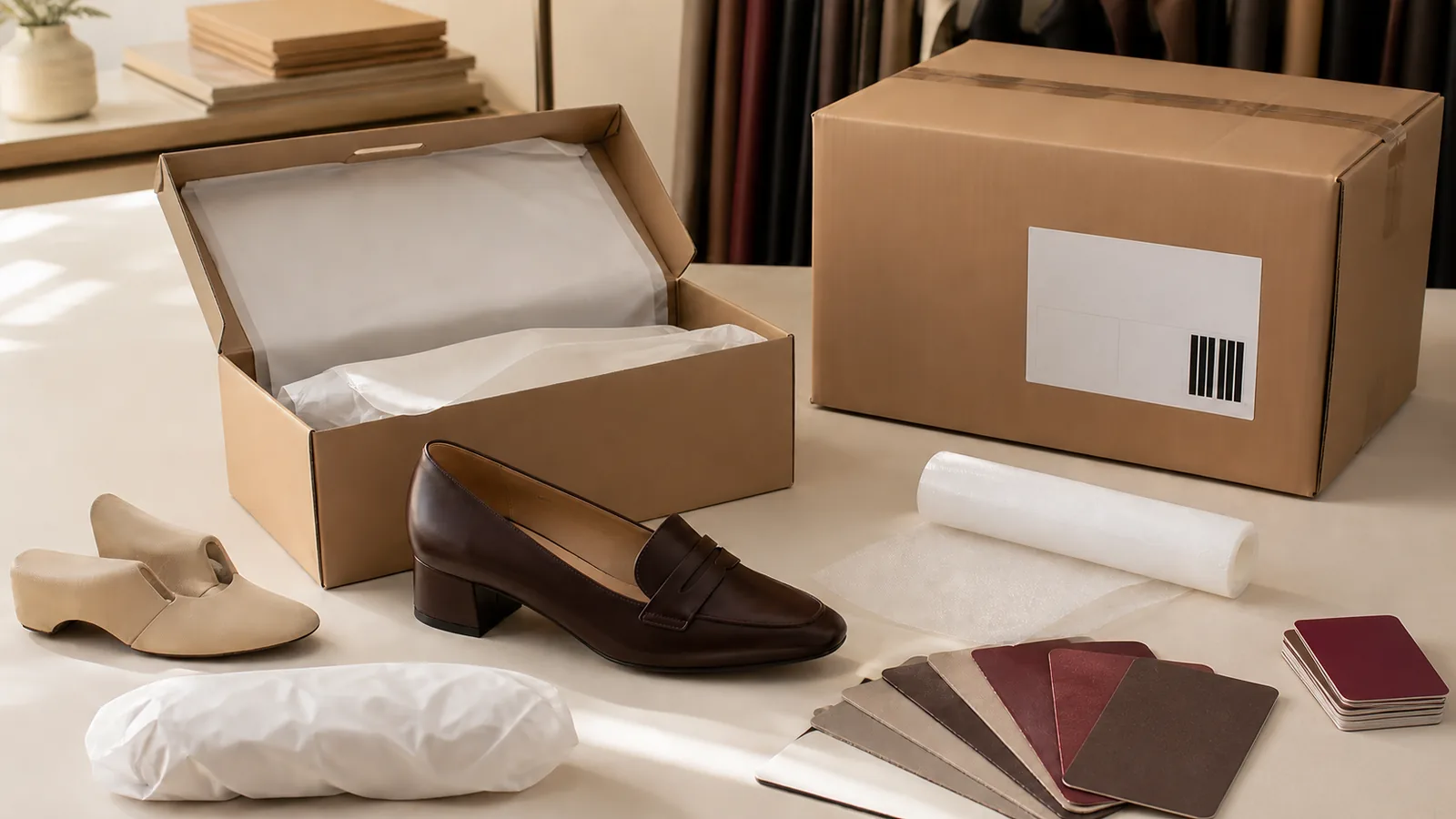
Approve footwear packaging as three linked systems: the mark on the shoe, the consumer-facing retail pack and the logistics carton. The product mark supports legal identification; the retail box helps stores and customers identify the correct pair; the export carton protects and routes the order. If one system is copied from another market without review, an otherwise acceptable shipment can be delayed, relabeled or rejected.
There is no worldwide “shoe box label.” Requirements depend on destination, product, materials, claims and importer role. This checklist separates commercial fields from market-specific legal duties; obtain current advice before artwork release.
The three-layer control matrix
| Layer | Typical information | Main failure to prevent | Approval owner |
|---|---|---|---|
| Shoe/product | Country of origin, size, material information where required, traceability ID | Missing, hidden or removable mandatory mark | Importer/compliance team |
| Retail box or bag | Brand/style, color, size, barcode, pair quantity, operator details or warnings where required | Wrong pair in box; artwork conflicts with product | Brand merchandising + compliance |
| Master carton | Consignee/reference, style-color-size breakdown, quantities, carton number, dimensions, weights, handling marks | Warehouse mismatch, customs delay or transit damage | Logistics + warehouse |
Printing a field on the box does not necessarily cure a missing product mark. Confirm required placement and permanence for each destination.
Step 1: freeze the product identity before artwork
Create one controlled record that connects:
- Brand and style name or number.
- Color name and color code.
- Size system and size value.
- SKU and, if used, GTIN/barcode.
- Purchase order number and production batch/lot.
- Country of origin.
- Upper, lining/sock and outsole composition.
- Manufacturer, importer or responsible-person details as applicable.
The same style-color-size combination must match across the purchase order, packing list, box label and warehouse system. Generate barcodes from buyer-assigned data and scan a production print: contrast, laminate and resolution affect readability.
Step 2: build a destination-market label matrix
Use one row per country or sales region. These examples show why a universal file is risky:
| Destination | Official rule to review | Practical artwork checkpoint |
|---|---|---|
| European Union | Directive 94/11/EC for footwear materials; GPSR for product identification, operator details and safety information | Three footwear parts identified; required operator/traceability data and language reviewed |
| United States | 19 U.S.C. 1304 and 19 CFR Part 134 country-of-origin marking; product claims may trigger other rules | Origin can be found easily and remains until the ultimate purchaser; U.S. place names do not mislead |
| Multiple countries | Destination-specific consumer, packaging, EPR and language rules | Separate artwork versions or a reviewed multilingual panel |
For the EU material label, identify the upper, lining and sock, and outer sole using the prescribed pictograms or permitted text. Directive 94/11/EC uses an 80% rule: the material representing at least 80% of the upper or lining-and-sock surface area, or at least 80% of outer-sole volume, is declared; if none reaches 80%, state the two main materials. The label must be attached to at least one shoe in the pair and be visible, securely attached and accessible.
For ordinary EU consumer products, the General Product Safety Regulation has applied since 13 December 2024. Depending on supply-chain role, required information can include product identity, manufacturer and EU responsible-operator details, warnings and safety information. Physical packs and e-commerce records should use one approved data source.
In the United States, imported articles generally must show their English country of origin conspicuously, legibly and with sufficient permanence. A 2021 CBP ruling found that an unsealed disposable box imported with properly marked shoes did not need the shoes’ origin repeated when it had no conflicting locality references. This fact-specific ruling is not permission to omit product marking.
Step 3: design the retail shoe-box label
A practical box-end label often contains:
- Brand and style/SKU.
- Product description.
- Color name/code.
- Size and size system, clearly labeled.
- Barcode/GTIN when assigned by the buyer.
- Pair quantity.
- Country of origin or other regulatory data when required by the approved market matrix.
- Batch or production reference if used for traceability.
Lock variable data, size-system abbreviation, decimal convention, barcode quiet zone and minimum type size in one template. Before bulk printing, conduct a “three-way match” among the physical shoe, box label and purchase order across more than one size.
Step 4: specify protective packaging, not only graphics
The packaging specification should state:
- Box construction, board grade or agreed performance standard.
- Finished internal and external dimensions with tolerance.
- Tissue, inserts, stuffing, dust bag or moisture-control components.
- Surface finish, ink, adhesive and acceptable color variation.
- Ventilation needs and restrictions on staples or metal fasteners.
- Pair orientation and method for preventing abrasion, crushing and shape loss.
- Pack-out photographs for each shoe type.
Select moisture controls by material, route and season, including destination warnings where required. A boot, embellished pump and molded sandal need different protection even with identical branding.
Step 5: control master-carton marks and pack ratios
The buyer’s logistics manual should define every printed or applied field. A typical carton mark includes:
- Shipper and consignee references as instructed.
- Purchase order, style, color and size run.
- Pairs per carton and carton sequence, such as 12 of 80.
- Gross weight, net weight and carton dimensions with agreed units.
- Destination or distribution-center code.
- Handling symbols selected for the actual risk.
- Scannable logistics label when required by the retailer or warehouse.
Do not use unverified certification or generic “eco” marks. For solid-wood pallets, dunnage or crates, confirm the destination’s implementation of ISPM 15. The standard covers specified wood packaging and authorized treatment marks; processed products such as plywood and sufficiently thin wood are outside parts of its scope. Never recreate the mark as ordinary artwork.
Step 6: prepare for changing packaging rules
EU Regulation 2025/40 entered into force on 11 February 2025 and generally applies from 12 August 2026, with obligations phased in. Its harmonized material-composition sorting label is scheduled from 12 August 2028 or 24 months after relevant implementing acts enter into force, whichever is later.
Do not put a speculative harmonized symbol on 2026 boxes. Ask the EU importer to confirm current EPR registration, national sorting marks, composition records and transition plan.
Pre-production approval checklist
- Destination list and importer roles confirmed.
- Product, retail-pack and carton fields mapped separately.
- Country-of-origin placement reviewed for each market.
- EU three-part material label checked against the approved bill of materials where applicable.
- Responsible economic operator and traceability information reviewed.
- Every size/color barcode tested from a physical print.
- Box dimensions checked with the actual finished shoe and inserts.
- Master-carton ratio reconciled to the purchase order and packing list.
- Gross/net weights and dimensions measured, not estimated from a previous style.
- Solid-wood packaging status and ISPM 15 evidence confirmed if relevant.
- Golden packaging sample signed and retained.
- Any material, address, barcode or artwork change routed through written approval.
Make packaging a product release gate. D6’s OEM vs ODM guide explains the development route; the EU footwear compliance checklist covers EU records, material labels and REACH planning.
FAQ
Must the shoe box always show country of origin?
Rules vary by destination and facts. CBP has accepted some unsealed disposable boxes without a repeated shoe-origin mark when footwear was properly marked and the box had no misleading locality references. Confirm the exact shipment.
Is a barcode legally required on every retail shoe box?
Not universally. It is commonly a buyer, retailer or warehouse requirement. The buyer should assign the data, specify the symbology and test the printed result.
Can one EU material label be copied across similar styles?
Only if the declared compositions are actually the same. Verify upper, lining/sock and outsole materials against each style’s approved bill of materials and the directive’s 80% calculation.
Does ISPM 15 apply to paperboard shoe boxes?
No. ISPM 15 addresses specified wood packaging material used in international trade. It may apply to solid-wood pallets, crates or dunnage associated with the shipment; check the standard and destination implementation.
Should a factory select the EU responsible person for the buyer?
The supply chain must agree the legal role. Do not print a company merely because its address is available; the importer should approve identity and contact details.
Release the pack with the product
Send market, operator, barcode, protection and carton requirements at development start. Approve physical prints and a completely packed pair before bulk. For a packaging-ready custom shoe inquiry, send D6 the target countries, SKU structure, artwork and carton manual.
Sources & references
- EUR-Lex, *Directive 94/11/EC on footwear material labelling*: https://eur-lex.europa.eu/eli/dir/1994/11/oj/eng
- EUR-Lex, *Regulation (EU) 2023/988 on general product safety*: https://eur-lex.europa.eu/eli/reg/2023/988/oj
- EUR-Lex, *Regulation (EU) 2025/40 on packaging and packaging waste*: https://eur-lex.europa.eu/eli/reg/2025/40/oj
- U.S. Customs and Border Protection, *19 CFR Part 134—Country of Origin Marking*: https://www.ecfr.gov/current/title-19/chapter-I/part-134
- U.S. Customs and Border Protection, *Ruling N320979: country-of-origin marking of a shoe box* (8 September 2021): https://rulings.cbp.gov/ruling/n320979
- International Plant Protection Convention, *ISPM 15: Regulation of wood packaging material in international trade*: https://www.ippc.int/static/media/files/publication/en/2019/02/ISPM_15_2018_En_WoodPackaging_Post-CPM13_Rev_Annex1and2_Fixed_2019-02-01.pdf