
Footwear Insights
Women’s Footwear Trends Buyers Can Translate Into Commercial Orders

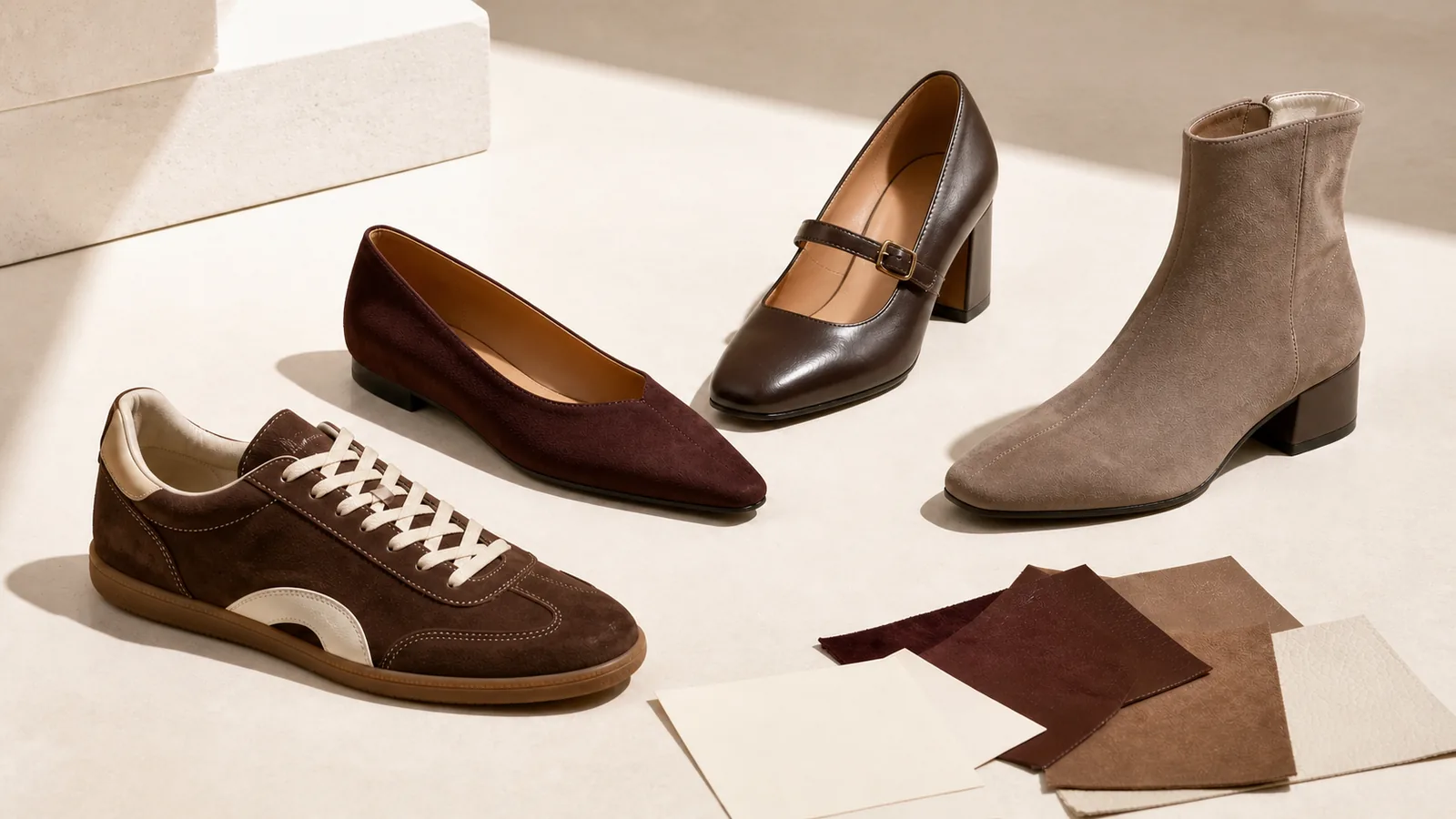
The most commercially usable 2026 women’s footwear signals are slim-profile shoes, pointed flats, Mary Janes, suede-led texture and softened boots—not an entire collection built around one runway story. Use a trend as one variable in the range architecture, then control silhouette, color, material, price and initial quantity separately.
That matters in a global market that produced 23.9 billion pairs in 2024, up 6.9%, while worldwide footwear exports rose 4.6% by volume. The World Footwear Yearbook 2025 also reports that Asia produced 88% of the world’s footwear. Buyers therefore face abundant supply, but abundance does not remove inventory risk: differentiation and disciplined order depth still matter.
What the latest trade-show data actually says
MICAM Milano’s FW26 Trends Buyer’s Guide was released for the February 2026 edition. MICAM and Livetrend say the analysis draws from e-commerce, social media, fashion shows and online consumer interest. It assigns trends different risk stages and reports year-on-year growth signals.
For women’s footwear, the guide highlights:
| Signal in MICAM FW26 guide | Reported YoY trend growth | Practical buyer translation | Suggested role |
|---|---|---|---|
| Soft and slim city sneaker | +300% | Low-profile upper, flexible sole, restrained branding | Volume test |
| Pointed flat | +26% | Pointed or softly tapered toe with a stable flat construction | Core-fashion bridge |
| Mary Jane high heel | +366% | Familiar pump last plus strap; keep heel height wearable | Controlled fashion bet |
| Suede sneaker | +36% | Texture update on an established sneaker shape | Seasonal core |
| Suede biker boot | +40% | Commercial shaft height with softened utility details | Cold-season statement |
| Slouchy heeled boot | +60% | Soft shaft and stable heel rather than extreme runway volume | Selective test |
These percentages are trend indicators from the guide, not retail sell-through forecasts. A +300% signal can start from a small base, and a visually strong trend can still miss a brand’s price point, climate or customer. Use the figures to prioritize samples and tests, not to justify an unqualified bulk order.
Five directions that can survive commercial editing
1. Slim sneakers: change proportion before changing the whole product
The low-profile sneaker is the easiest trend to translate because a buyer can retain a familiar upper pattern and modify sole thickness, toe shape, panel scale and color blocking. That reduces development risk compared with an entirely new construction.
For a first order, specify a neutral carryover color, one seasonal color and one material-led option. Require flex, bonding and abrasion checks on the production materials; slim soles make inconsistent foxing or bonding more visible.
2. Pointed flats: fashion impact with a fit warning
A pointed flat can refresh office, occasion and smart-casual ranges without adding heel-height risk. The commercial challenge is internal length and toe-box volume. Do not approve the last from a side-view image alone.
Fit-test the middle size and both ends of the planned run for heel grip, topline pressure and toe clearance. A softly tapered toe usually serves a broader customer than an extreme point. Let a proven neutral carry depth and use one contrast toe or seasonal color as the fashion story.
3. Mary Janes: use the strap as the adjustable trend lever
MICAM’s guide gives the Mary Jane high heel one of the strongest reported women’s signals. Commercially, the strap creates visible identity while the underlying last can remain familiar. Buyers can vary strap width, buckle scale, toe shape and heel height across price tiers.
Test strap hole placement, edge finish and walking flex, and state whether it is functional. A moderate heel and secure topline usually offer broader wearability than an exaggerated runway shape.
4. Suede and tactile surfaces: treat material as a managed update
MICAM’s FW26 direction moves away from polished perfection toward tactility and worn-in character. The guide reports +36% for suede sneakers and +40% for suede biker boots. Texture is commercially useful because it can update an established SKU without creating a new sole mold.
Approve color, nap direction, rub-off and panel-to-panel variation under agreed lighting. Confirm destination-market chemical and colorfastness tests. “Natural variation” should never be an undefined tolerance.
5. Soft boots: edit drama to climate and channel
Slouch, softened shafts and utility references fit the guide’s tactile FW26 mood. Translate them according to channel: a department-store buyer may accept a higher shaft and richer material, while an e-commerce brand may prioritize packability, weight and clear fit imagery.
Confirm calf circumference, shaft height, topline opening and lining friction. Because boots consume freight and warehouse space, model the costed master-carton pack—not only the ex-factory price.
A safer range architecture
A practical first-season matrix avoids asking one SKU to prove both a new silhouette and an untested material:
| Range layer | Share of styles | Design approach | Initial-order approach |
|---|---|---|---|
| Core | 50–60% | Proven lasts and colors, small detail updates | Deepest size curve after historical review |
| Core-fashion bridge | 25–35% | One current signal on a familiar construction | Moderate quantity, replenishment option if possible |
| Fashion test | 10–20% | Stronger color, shape or texture | Shallow depth, concentrated in best customer sizes |
Adjust these planning ranges using sell-through, return reasons, climate and reorder ability.
Convert a trend board into an order brief
Before requesting samples, give the factory a decision-ready brief:
- Target market, channel, retail price and required landed-cost ceiling.
- Reference silhouette plus the exact elements that may and may not change.
- Last shape, fitting standard, size range and proposed size curve.
- Upper, lining, sock and outsole materials with approved alternatives.
- Color standards, hardware finish and surface-variation tolerance.
- Packaging dimensions, labeling market and master-carton constraints.
- Wear-test, physical-test and chemical-test requirements.
- Sample stages, approval owners and bulk release date.
If the construction route is still unclear, compare OEM and ODM shoe development before locking the calendar. For heel-led ideas, D6’s custom high heel development page shows the kinds of specifications a buyer should prepare. Buyers planning warm-season assortments can also review the sandals category as a starting point for a more precise inquiry.
Buyer checklist before placing the order
- Separate the trend evidence from the brand’s own sales evidence.
- Score each proposed SKU for newness, fit risk, material risk and tooling risk.
- Place fashion depth only after reviewing a physical sample and costed packaging.
- Fit-test every new last; do not infer fit from a neighboring style.
- Freeze material, color and hardware standards before bulk cutting.
- Agree inspection criteria and the approved sample used as the reference.
- Review size curve by channel instead of applying one curve to every SKU.
- Keep a replenishment decision date and the data needed to trigger it.
FAQ
Which women’s footwear trend is the lowest-risk first test?
A slim sneaker or suede update on an existing construction is often easier to control because the last or sole can remain familiar. The correct choice still depends on the brand’s customer and historical returns.
Does the highest trend-growth percentage deserve the largest order?
No. Trend growth is not the same as sales volume or brand fit. Use it to prioritize development, then set quantity using comparable sales, margin, lead time and replenishment capability.
How many colors should a new trend SKU launch in?
A disciplined test often uses one proven neutral plus one directional color or material. Too many colorways fragment size depth and obscure results.
Should every trend require a new outsole mold?
No. Upper pattern, toe shape, material, hardware and color can create a meaningful update on an existing construction. Reusing a suitable sole can shorten development and reduce tooling exposure.
How should a buyer handle unusual suede or distressed finishes?
Approve a physical standard and define acceptable variation, colorfastness, rub-off and restricted-substance testing. The purchase order should require written approval for any material or finish substitution.
Build the test around the customer, not the forecast
Select one or two signals that fit the customer, turn them into measurable specifications, and buy a size-and-color test that can produce a clear decision. To discuss a private-label women’s footwear project, send D6 the target market, reference images and commercial requirements.
Sources & references
- MICAM Milano and Livetrend, *MICAM 101 FW26 Footwear Trends Buyer’s Guide* (February 2026): https://micam.it/wp-content/uploads/2026/02/3.-BUYERGUIDE_MICAM101_ENG.pdf
- MICAM Milano, *The first AI-generated Trend Guide debuts at MICAM* (September 2025): https://micam.it/wp-content/uploads/2025/08/THE-FIRST-AI-GENERATED-TREND-GUIDE-DEBUTS-AT-MICAM-TO-REDUCE-UNSOLD-STOCK.pdf
- MICAM Mag, *Spring/Summer 2026 Footwear on the Catwalk* (11 September 2025): https://mag.micam.it/en/spring-summer-2026-footwear-on-the-catwalk/
- APICCAPS, *World Footwear Yearbook 2025: global footwear production increases 6.9%* (25 August 2025): https://www.apiccaps.pt/news/producao-mundial-de-calcado-aumenta-69/10855.html