
Footwear Insights
Shoe Sole Materials Compared: Rubber, TPR, EVA, TPU and PU

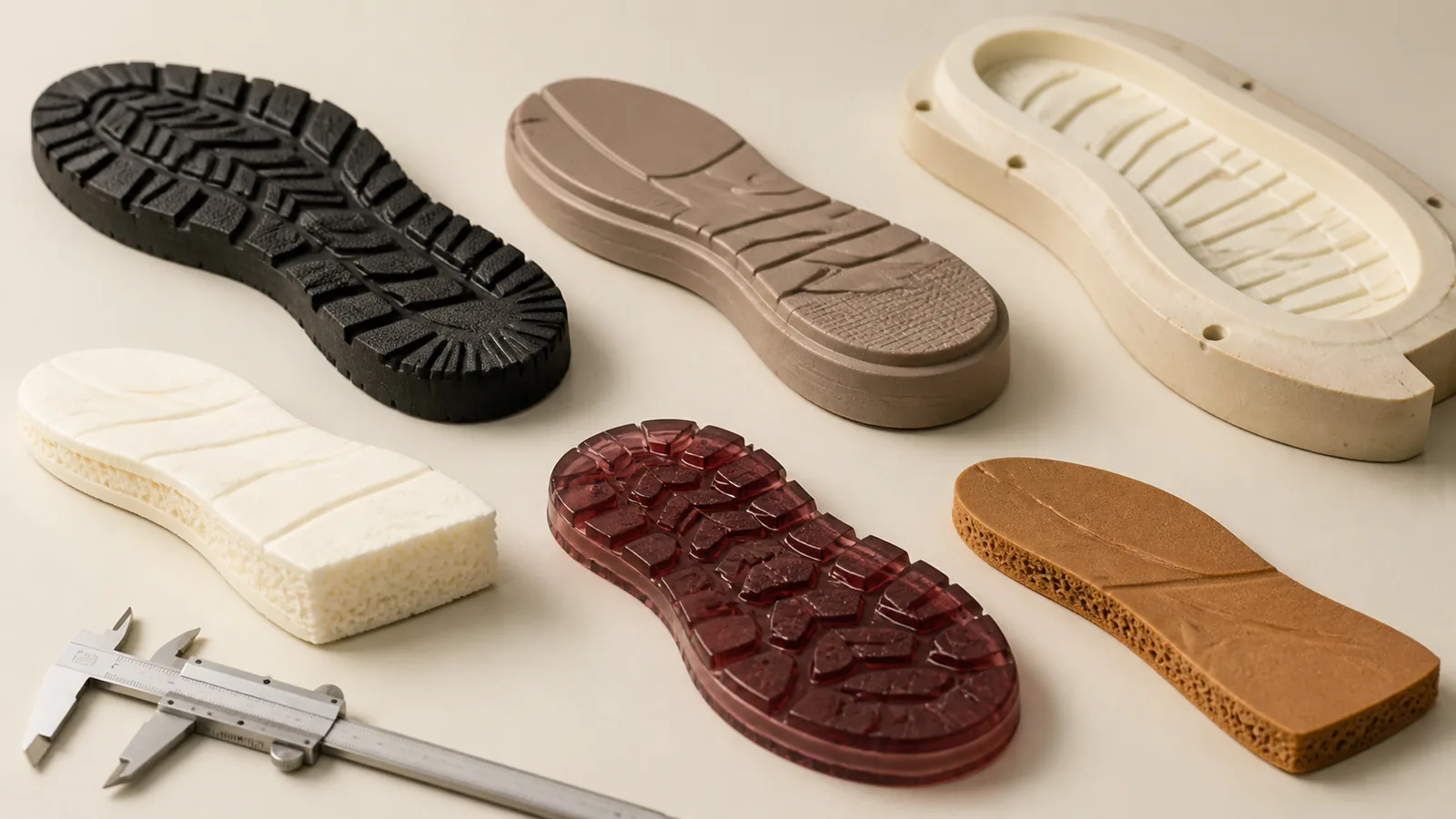
Select a sole material from the shoe’s use case and construction, then qualify the exact compound. Rubber is a common choice for durable, traction-focused outsoles. TPR offers thermoplastic processing and broad styling options. Foamed EVA is useful when low weight and cushioning are priorities. TPU suits thin, tough or highly defined outsole parts. PU can be formulated into lightweight, cushioned unit soles. These are starting tendencies—not guaranteed rankings—because density, hardness, tread, fillers, foaming and processing can change performance substantially.
Compare production-intent units for abrasion, flex, tear, dimensional stability, bond and slip. A resin family name is not a footwear specification.
Rubber, TPR, EVA, TPU and PU at a glance
| Material family | Common footwear role | Useful buying reason | Risks to qualify |
|---|---|---|---|
| Rubber | Outsole or contact layer | Broad compound options; often selected for wear and traction briefs | Weight, blooming, color migration, cure consistency, flex cracking |
| TPR | Injection-molded outsole or unit sole | Mold detail, color options and thermoplastic processing | Heat deformation, abrasion, low-temperature flex, compound variation |
| EVA | Foamed midsole, outsole or one-piece sole | Low density and cushioning potential | Compression set, shrinkage, tearing, surface wear, dimensional variation |
| TPU | Thin outsole, insert, film or support component | High definition and potential abrasion/tear performance | Cost, density, squeak, processing window, hydrolysis risk by chemistry |
| PU | Direct-injected or molded unit sole/midsole | Density and cushioning can be engineered across formulations | Hydrolysis, voids, skin defects, ageing, density inconsistency |
Do not award an automatic winner. These families span many blends, hardnesses and densities. Request the compound code, construction drawing and test results for the exact sole.
Rubber soles: when contact performance leads the brief
Rubber is frequently used as the ground-contact layer on casual, fashion and performance-inspired footwear. Formulators can adjust hardness, fillers and tread interaction for the product brief. That flexibility is useful, but it means results from one rubber compound cannot be transferred to another.
Procurement should check mass, hardness, abrasion, flex cut growth, tear and slip on the finished design. For light-colored uppers, assess color migration from dark rubber and any surface bloom after storage. Vulcanized parts also need stable cure and dimensions; an under- or over-cured compound may not behave like the approved sample.
TPR soles: when moldability and commercial versatility matter
Thermoplastic rubber (TPR) is a broad commercial name for rubber-like thermoplastic compounds used in injection-molded soles. It can reproduce tread and sidewall details and is available in many appearances. It is often considered for fashion, children’s and general casual footwear.
Thermoplastic processing does not prove that a finished sole is recyclable in the buyer’s collection system. Avoid circularity claims without construction and collection evidence.
EVA soles: when low mass and cushioning are priorities
Ethylene-vinyl acetate (EVA) is widely used in foamed midsoles and one-piece casual soles. Foaming lowers density and can provide a soft step-in feel, making EVA attractive for slippers, sandals and lightweight shoes.
The trade-off is that foam structure drives performance. A softer, lower-density formulation may show more compression, tearing or surface wear than a denser design. Specify density and hardness tolerances, but also test compression behavior and dimensions after conditioning. Mold shrinkage and post-molding stabilization can affect fit with the upper or outsole sheet.
Check wear and slip on a one-piece EVA tread, or interlayer bond for an EVA-and-rubber unit. D6’s custom slipper development page shows why upper, footbed and sole should be discussed together.
TPU soles: when thin geometry and toughness matter
Thermoplastic polyurethane (TPU) is used for outsoles, inserts, shanks, films and decorative/support parts. It can hold fine molded geometry and certain grades can provide strong abrasion and tear performance, which is useful where the contact layer must be relatively thin.
TPU is not a single formula. Chemistry, hardness and additives change its response to moisture, UV, chemicals and temperature. Ask the compound supplier to recommend a grade for the environment, then validate ageing.
Also evaluate sound and friction against the chosen flooring: squeak is an interaction between sole, surface, moisture and construction, not a property name that can be eliminated on paper.
PU soles: when the unit sole needs engineered density
Polyurethane (PU) soles are commonly produced by reacting components in a mold, including direct injection onto the upper in suitable constructions. Formulation and process can create a relatively light sole with an integral surface skin and cushioned interior.
Mixing ratio, temperature and mold conditions can affect density, cells, surface and bond. For warm, humid storage or use, agree an ageing protocol with the lab and PU system supplier.
Avoid treating a short unaged flex test as a complete durability answer. Inspect aged soles for cracking, crumbling, bond loss and changes in mechanical results.
Six metrics buyers should understand
| Metric | What it answers | Procurement caution |
|---|---|---|
| Density | How much mass occupies a given volume | Compare test method and foamed/solid construction; low density is not automatically better |
| Hardness | Resistance to indentation | State the scale, method and conditioning; values on different Shore scales are not interchangeable |
| Abrasion resistance | How the material responds to controlled wear | ISO 20871 is material-neutral; compare like specimens and reporting units |
| Flex resistance | Whether an initiated cut grows under repeated bending | ISO 17707 applies within its stated outsole rigidity scope; record cut growth and cycles |
| Tear/split tear | Resistance to propagation or layer separation | Use ISO 20872 or ISO 20875 as relevant to the construction |
| Dimensional stability | Whether heat exposure changes sole dimensions | ISO 20873 helps assess outsole change after defined conditions |
Add upper-to-sole adhesion for the assembled shoe. A high-performing outsole compound can still fail if surface preparation, adhesive, primer or bonding time is wrong. Slip resistance should also be checked on the complete shoe with the intended tread, contaminant and surface method; material type alone cannot predict it reliably.
A sole qualification plan that reduces surprises
- Write the use case: consumer, terrain, climate, wear frequency, target mass and price.
- Draw the construction: outsole, midsole, inserts, thicknesses, tread and bonding interfaces.
- Obtain compound codes, technical data and processing/ageing recommendations.
- Test molded production-intent units, not only flat material plaques.
- Test the assembled shoe for bond and slip risks.
- Condition for relevant heat, humidity, cold or storage, then repeat critical tests.
- Seal the approved unit, color and compound code; prohibit unapproved substitutions.
The correct acceptance limits depend on footwear category and market. ISO/TS 20939:2024 establishes performance requirements for footwear outsoles by end use and identifies test methods for evaluating them. Use it, customer requirements and laboratory advice to set the purchase-order limits.
Questions to send with an outsole RFQ
- Is the proposed material a solid compound, microcellular foam or multi-density unit?
- What are its compound code, nominal density and hardness tolerance?
- Which ISO test methods and conditioning were used in the data sheet?
- Does the quotation include a mold, and who owns it?
- How will shrinkage, mass, color and surface defects be controlled?
- Which primer/adhesive is approved, and which changes trigger retesting?
For molded heels or more structured fashion constructions, review the style, heel height, last, outsole and target market together. The D6 custom high heel workflow shows the project details needed before a useful sampling discussion.
FAQ
Is a rubber sole always more slip-resistant than EVA or TPR?
No. Slip depends on compound, hardness, tread geometry, contact area, surface and contaminant. Test the complete shoe using the method relevant to the target market and use case.
Why do PU soles sometimes crumble in storage?
Some polyurethane systems can degrade through hydrolysis under moisture and heat, with risk affected by chemistry, stabilisation, processing and storage. Select the system for the environment and validate aged performance.
Build the outsole brief before requesting a quote
Send the shoe type, target market, expected wear, construction drawing, size range, target unit mass, tread reference, material shortlist, test requirements and launch quantity. Then contact D6 with the project requirements to discuss a sampling route without assuming that one material name solves every performance need.
Sources & references
- ISO, *ISO/TS 20939:2024 — Performance requirements for footwear outsoles*: https://www.iso.org/standard/86527.html
- ISO, *ISO 20871:2018 — Abrasion resistance of outsoles*: https://www.iso.org/standard/63230.html
- ISO, *ISO 17707:2005 — Flex resistance of outsoles*: https://www.iso.org/standard/31478.html
- ISO, *Footwear standards catalogue*, including ISO 20872, ISO 20873 and ISO 20875: https://www.iso.org/ics/61.060/x/
- ASTM International, *ASTM D2240 — Rubber property, durometer hardness*: https://www.astm.org/d2240-15r21.html
- BASF, *Elastollan TPU for the footwear industry* (supplier application reference): https://plastics-rubber.basf.com/global/en/performance_polymers/products/elastollan/elastollan_for_thefootwearindustry