
Footwear Insights
How to Choose Shoe Upper Materials: Leather, PU, Microfiber and Textile

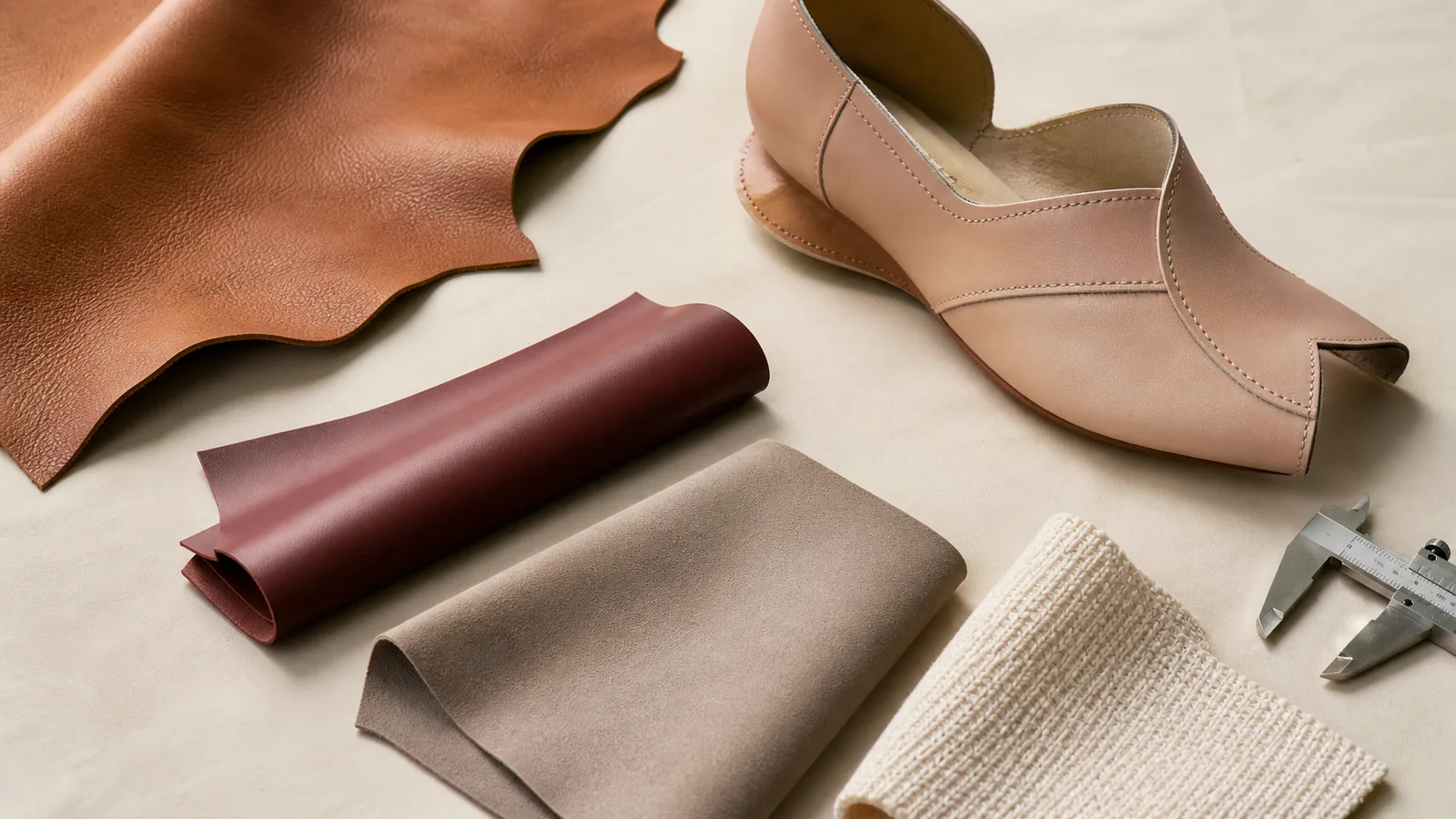
Choose a shoe upper material from the product brief, not from the material name alone. Leather suits products where natural character and shaping are central. PU-coated synthetics provide repeatable appearance. Microfiber-based synthetics offer a fine, leather-like structure. Textiles are useful when low mass, ventilation or engineered stretch matters. None is automatically “best”: backing, coating, thickness, finish, color and construction can change the result.
Shoe upper materials compared
| Buying factor | Leather | PU-coated synthetic | Microfiber-based synthetic | Woven or knitted textile |
|---|---|---|---|---|
| Typical structure | Animal hide with finish or coating | Fabric backing plus polyurethane surface layer | Fine-fiber nonwoven base, commonly impregnated and/or coated | Interlaced yarns or engineered knit, sometimes laminated |
| Visual character | Natural grain and piece-to-piece variation | Highly controllable color, grain and gloss | Fine, uniform leather-like appearance; grade varies | Wide choice of yarn, weave, knit, mesh and pattern |
| Pattern and lasting behavior | Often forms well, but hide direction and defects need control | Depends strongly on backing, thickness and coating flexibility | Often consistent across the roll; verify stretch and recovery | Can fray, stretch or distort unless construction is controlled |
| Moisture management | Depends on leather type and finish | A dense coating may limit vapour transfer | Depends on base and coating, not the “microfiber” label | Open structures can ventilate; laminations can change this |
| Main production risks | Shade, grain, usable cutting yield, finish cracking | Hydrolysis, surface cracking, delamination, backing show-through | Grade substitution, coating damage, delamination | Fraying, seam slippage, snagging, color bleeding, distortion |
| Best first question | Which hide type, finish and usable-area standard? | What are the backing, coating chemistry and ageing results? | What is the complete layer construction and test history? | What are the fiber content, construction, weight and stretch direction? |
The table is a screening tool, not a performance guarantee. Two black PU materials with the same thickness can behave differently because their backing and coating systems differ. Likewise, a tight woven textile and an open engineered knit should not share one generic specification.
When leather is the better choice
Leather is usually the strongest commercial fit when customers expect a natural grain, a shaped formal silhouette or the feel associated with leather footwear. Its variation is part of its appeal, but it also creates cutting and color-control work.
Define the animal species and leather type—not simply “genuine leather”—plus finish, embossing, thickness tolerance, shade/grain acceptance and usable cutting-area standard. For light colors, test contact with linings, socks and adjacent materials. For a highly flexed vamp, assess the finished leather after repeated flexing rather than judging an unflexed swatch.
EU buyers should also map chemical risks. Under REACH Annex XVII, leather articles—or leather parts of articles—that come into direct and prolonged skin contact cannot be placed on the market when chromium VI is present at 3 mg/kg or more. Whether a particular upper presents that contact scenario needs to be assessed from the shoe design and intended use.
When PU-coated synthetic is the better choice
PU-coated synthetic is useful when the brief calls for a repeatable grain, specific gloss, printed surface or tighter visual uniformity across production. It may also simplify nesting compared with natural hides because it is supplied in rolls.
Do not approve it from face appearance alone. Request the full construction: backing type, total thickness, usable width, mass per area, coating type and intended footwear use. Key failure modes include surface cracking at flex points, coating separation, poor seam holding and degradation during heat-and-humidity exposure.
For warm or humid supply chains, agree an ageing protocol with the laboratory and repeat the critical flex or peel test after conditioning.
When microfiber-based synthetic is the better choice
“Microfiber” describes a family of constructions, not one fixed material. In footwear, the term often refers to a fine-fiber nonwoven substrate combined with a polymer system. It can be a good option when the buyer wants a fine, consistent surface and predictable roll supply.
Its sourcing risk is specification drift. A quotation may use the same commercial name for materials with different bases, coatings or thicknesses. Lock an approved swatch, supplier code and layer construction into the bill of materials. Test the exact production color because pigments and finishes can affect flexing, rubbing and heat response.
For recycled-content, lower-impact or “vegan” claims, obtain claim-specific composition and chain-of-custody evidence. “Microfiber” alone proves neither composition nor impact.
When textile is the better choice
Textile uppers work well for casual, slipper, sandal and athletic-inspired products where ventilation, flexibility, color or low weight is important. Woven fabrics can provide stable panels; engineered knits can place stretch and openness in selected zones. Laminated textiles can add structure, but the foam, film and adhesive then become part of the performance system.
Specify fiber content, construction, mass per area, usable width, stretch/recovery by direction and backing. Check cut-edge fraying, topline distortion and color rubbing.
Performance tests that make quotations comparable
Start with the end use, then select methods. The ISO footwear standards below are material-neutral, which is useful when comparing candidates:
| Performance question | Relevant method | What the buyer should record |
|---|---|---|
| Will the upper crack or break at repeated bend points? | ISO 17694 flex resistance | Method, conditioning, cycles and failure description |
| Can the material and seam resist pulling? | ISO 17696 tear; ISO 17697 seam strength | Direction, specimen construction and result |
| Will layers separate? | ISO 17698 delamination resistance | Initial and, if relevant, aged result |
| Will lining or upper wear through? | ISO 17704 wet and dry abrasion | Face tested, wet/dry condition and endpoint |
| Will color transfer to socks or adjacent panels? | ISO 17700 rubbing and bleeding | Dry/wet result and staining scale |
| Does the construction manage perspiration? | ISO 17699 water-vapour permeability and absorption | Result for the complete upper/lining combination |
| Does the upper resist water entry for its intended use? | ISO 17702 water resistance | Method details and acceptance criterion |
Avoid copying one universal pass mark from another brand. ISO/TS 20952:2024 establishes performance requirements for footwear upper components by end use and can help the supplier, buyer and laboratory select a more relevant requirement set. Your purchase order should state the chosen method, specimen condition, sample stage and acceptance value.
A seven-step upper-material approval workflow
- Define shoe type, target price, climate, care expectation and intended wear.
- Request coded swatches with complete construction and supplier details.
- Shortlist by hand, appearance, cutting behavior and preliminary test evidence.
- Make a full sample in the intended color, lining, reinforcement and seam construction.
- Test the risks created by the use case—not every test available.
- Seal the approved swatch, color tolerance and supplier code with the sample.
- Require written approval for any backing, coating, dye, finish or source change.
For a precise vamp, heel counter or strap, the D6 high heel development workflow lists the inputs needed to turn a reference into a sample brief.
FAQ
Is microfiber the same as PU leather?
Not necessarily. A microfiber-based synthetic can include a polyurethane system, but “microfiber” refers to the fine-fiber substrate or structure, while “PU leather” is used broadly for polyurethane-surfaced synthetics. Ask for the layer construction instead of relying on the sales name.
Which shoe upper is the most breathable?
There is no safe ranking by material name. An open knit may move vapour readily, while a laminated or coated version may not. Leather and synthetic results also depend on finish, thickness and the lining system. Test the complete construction using an agreed method such as ISO 17699.
What should be attached to the purchase order?
Attach the approved material code and swatch, supplier, construction, thickness tolerance, color standard, restricted-substance requirements, test methods, acceptance values and substitution rule.
Turn the material choice into a sample specification
Send the shoe type, target market, reference images, expected upper behavior, shortlisted materials, colors and test requirements—not just “leather” or “microfiber.” Then contact D6 with the project brief to discuss how those inputs can be developed into a sample.
Sources & references
- ISO, *ISO/TS 20952:2024 — Performance requirements for footwear upper components*: https://www.iso.org/standard/86528.html
- ISO, *ISO 17694:2016 — Flex resistance of uppers and linings*: https://www.iso.org/standard/60978.html
- ISO, *ISO 17697:2016 — Seam strength*: https://www.iso.org/standard/60979.html
- ISO, *ISO 17704:2004 — Wet and dry abrasion resistance*: https://www.iso.org/standard/38260.html
- ISO, *Footwear standards catalogue*, including ISO 17696, ISO 17698, ISO 17699, ISO 17700 and ISO 17702: https://www.iso.org/ics/61.060/x/
- European Chemicals Agency, *Scope of the REACH chromium VI restriction for leather*: https://echa.europa.eu/documents/10162/17233/restriction_setting_a_clear_scope_en.pdf/36045edb-5135-f188-265b-b641a4177c93?t=1608726372627