
Footwear Insights
Shoe MOQ Explained: What Drives Minimum Order Quantity

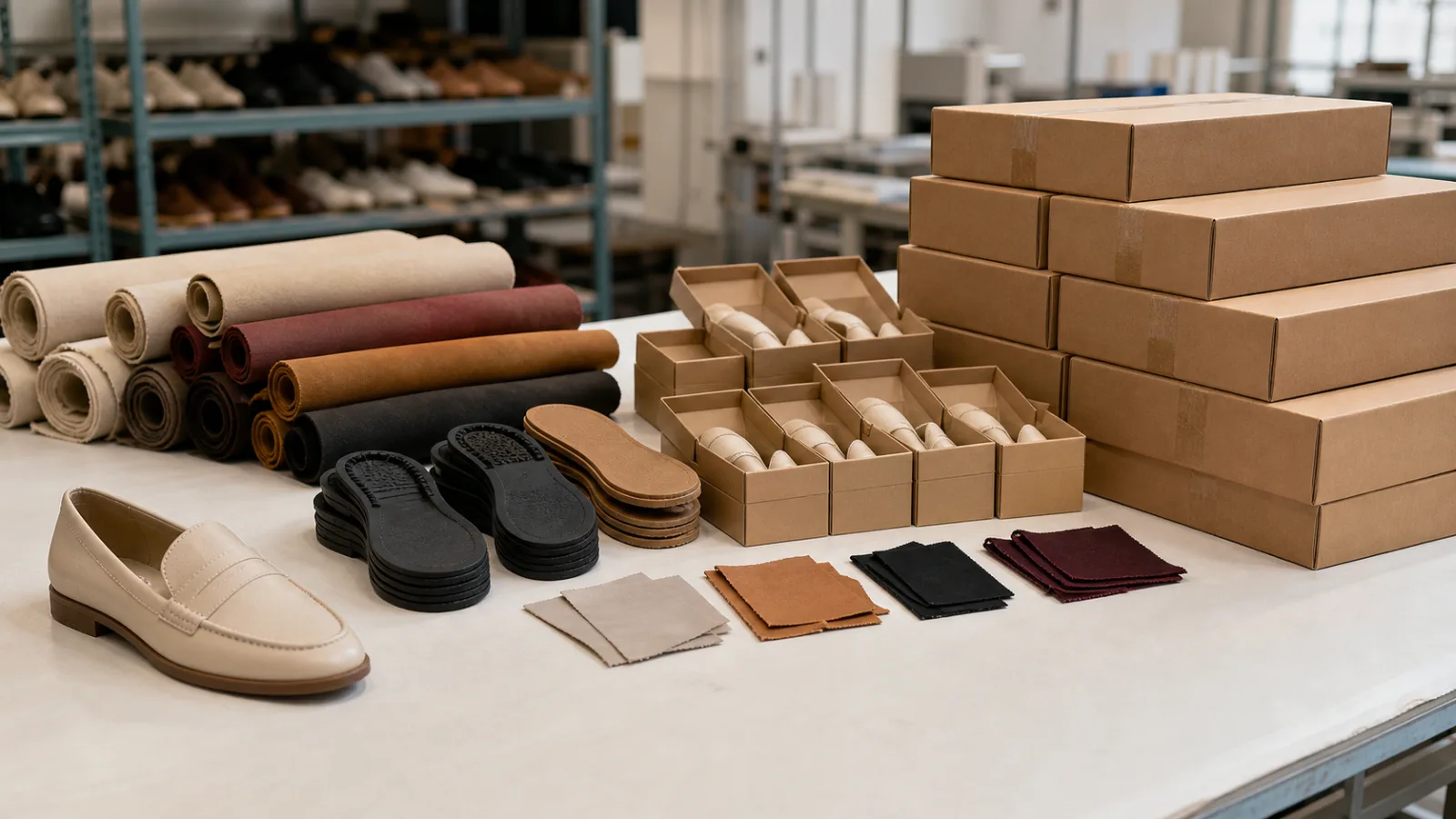
Shoe MOQ is the smallest commercially workable order for a defined style, color mix and size range—not one universal factory number. The effective minimum is usually set by the least flexible input: material purchase, outsole or hardware batch, color processing, packaging print run, tooling economics or production setup. To negotiate it, give the factory a complete SKU plan and ask which constraint creates each minimum.
D6’s public website says most styles start at 300–1,000 pairs, depending on material and customization. Treat that as an initial discussion range, not a quote or guarantee; the exact design, colors, sizes, components and packaging determine the order structure.
MOQ by style, color and SKU are different
| Term | Meaning | Example question |
|---|---|---|
| Style MOQ | Minimum total pairs for one construction/design | Can 600 pairs combine two colors? |
| Color MOQ | Minimum pairs using one material color or finish | Does each color need 300 pairs? |
| Size minimum | Lowest workable quantity in a particular size | Can edge sizes have 12 pairs each? |
| SKU quantity | Pairs for one exact style-color-size combination | How many pairs of burgundy EU 38? |
| Material MOQ | Supplier’s minimum purchase for one specification | How many meters must be bought per color? |
| Component MOQ | Minimum batch for an outsole, buckle, heel or label | Can one component serve several styles? |
Require this hierarchy in writing. “MOQ 500” is ambiguous without a style, color, material or order basis.
A useful way to model shoe MOQ
Think of the commercial minimum as the highest applicable constraint:
Effective MOQ = maximum of material-derived quantity, component batch, color/process batch, packaging batch and viable production quantity.
For example, suppose an upper material supplier requires a 300-meter color lot and the planning consumption is 0.45 meter per pair. Before yield loss, the material supports about 667 pairs (300 ÷ 0.45). If the same approved color and material can serve two styles, the factory may be able to spread that purchase across both. This is illustrative arithmetic, not a D6 consumption rate or supplier minimum.
Ask for the purchase unit, usable width, consumption, yield allowance and treatment of surplus.
What drives a shoe factory’s minimum order?
1. Materials and custom colors
Mills, tanneries and material distributors sell in rolls, hides, sheets, batches or color lots. A stock beige microfiber may be available in a small quantity while a custom dyed textile requires a full production batch. Lining, sock material, foam, thread and edge paint can each have separate constraints.
Color fragmentation adds shade approvals, cutting separation, line clearance, matching and inventory. Four small colors can be harder than one equal-sized total.
2. Lasts, outsoles, heels and tooling
A new outsole or heel may require molds and trials across the size range. Existing components reduce exposure only when shape, fit, performance and size coverage suit the design.
Record who pays for, owns, stores, maintains and may reuse each mold. A tooling payment does not automatically answer those contractual questions.
3. Hardware, branding and packaging
Buckles, zippers, labels, insoles, tissue, boxes and cartons can have separate color, finish or print minimums. Packaging is often overlooked until shoes are ready.
GS1’s GTIN Management Standard provides rules for identifying trade items and changes such as primary brand, pack quantity and predefined assortment. Barcode assignment does not determine factory MOQ, but every color/size assortment must be planned accurately so labels and cartons match the saleable SKUs.
4. Production setup and line balance
Cutting dies, settings, first-piece approval and line changeovers consume time before stable output. Viable batch size depends on construction and operation count, not factory size alone.
Ask which workstation is the constraint. “The line minimum” is less useful than “this molded outsole supplier requires a batch per color” or “the plated buckle has a finish minimum.”
5. Size range and order curve
Factories need a realistic size curve for components, packing and mold use. Equal quantities rarely match demand; tiny edge-size quantities can be inefficient.
Give expected sales percentages by size and confirm rounding rules. Also state the size system and last; a label such as EU 38 does not by itself guarantee identical fit across lasts or brands.
How can a buyer lower MOQ without damaging the product?
| Strategy | Constraint it may reduce | Trade-off to confirm |
|---|---|---|
| Use an existing last and outsole | Tooling and size-set development | Less exclusive bottom construction |
| Share one upper material across styles | Material and color lot | Design palette becomes more coordinated |
| Launch fewer colors | Dye lot, setup and packaging variants | Narrower initial assortment |
| Use stock material or color | Custom material production | Availability may change; reserve it |
| Standard box plus branded label | Printed packaging run | Less custom unboxing |
| Concentrate the size curve | Very shallow size quantities | Must be based on real customer demand |
| Approve a paid material surplus | Converts quantity into cost | Storage, ownership and future shade match matter |
| Place a repeat framework order | May improve supplier planning | Requires credible forecast and contract terms |
The best negotiation question is: “Which exact input prevents this quantity, and what approved change removes that constraint?” This invites engineering rather than a generic discount request.
Low MOQ does not always mean lower risk
A smaller order limits inventory exposure, but development, setup, testing and logistics are spread across fewer pairs. It may also leave surplus material.
Compare total cash at risk rather than unit price alone:
| Cost bucket | Include in the decision |
|---|---|
| Product | Pair price and quantity tolerance |
| Development | Samples, patterns, lasts and molds |
| Compliance | Testing, labels and documentation |
| Quality | Inspection, rework and retained samples |
| Packaging | Consumer boxes, labels and cartons |
| Logistics | Freight, insurance, duty and inland delivery |
| Excess input | Purchased material/components not converted into shoes |
A larger standard-component order may lower landed cost but increase inventory; a smaller custom order may do the reverse. Model both.
What should you send for an accurate MOQ answer?
Provide a drawing or factory-ready footwear tech pack, expected total pairs, color split, size curve, target materials, branding, packaging, destination market and launch date. Ask the factory to return:
- MOQ per style, color and special component.
- The binding constraint behind each number.
- Price tiers above the minimum.
- Tooling and sample costs.
- Excess-material quantity, ownership and storage terms.
- Approved alternatives that reduce the minimum.
- Whether quantities can combine across colors or styles.
If demand is still being tested, D6’s OEM versus ODM comparison explains how an existing development platform may reduce avoidable complexity.
FAQ
Is shoe MOQ quoted per design or per color?
It can be either—or both. Require the quotation to state style total, color minimum, component minimum and allowed size assortment.
Why does changing one color increase MOQ?
The new color may trigger a separate material lot, dye or plating setup, thread purchase, production changeover and packaging SKU.
Can different sizes be combined in one MOQ?
Usually a style/color quantity is distributed across sizes, but component availability and packing rules still apply. Agree the size curve before price confirmation.
Will paying more always reduce MOQ?
No. A surcharge can cover setup or unused material, but it cannot always make a supplier produce below a technical batch or tooling constraint. Ask what the surcharge actually solves.
Should a startup order the absolute minimum?
Order the smallest quantity supported by demand evidence and a viable product specification—not automatically the lowest number offered. Include replenishment time and cash tied in inventory.
Find the constraint before negotiating the number
Send D6 your style, quantity, colors, size curve, materials and packaging. Ask for a written MOQ breakdown and the alternatives that preserve the features customers will notice.
Sources & references
- D6 Shoe Factory, published service and MOQ information: https://d6shoe.com/
- OECD, *Due Diligence Guidance for Responsible Supply Chains in the Garment and Footwear Sector*: https://www.oecd.org/content/dam/oecd/en/publications/reports/2018/03/oecd-due-diligence-guidance-for-responsible-supply-chains-in-the-garment-and-footwear-sector_g1g89b0b/9789264290587-en.pdf
- GS1, *GTIN Management Standard*: https://www.gs1.org/1/gtinrules/en/
- World Footwear, *World Footwear Yearbook 2025 sample*: https://www.worldfootwear.com/media/wf_uploads/wf202531587451624.pdf